City Air Conditioning in Fort Myers and Southwest Florida: What Homeowners Need to Know
City air conditioning means keeping your home cool and your AC system running dependably in a Florida city, where heat, humidity, and salt air push equipment harder than almost anywhere else in the country. In Fort Myers, Cape Coral, and Naples, most systems run nearly year round, so small problems turn into big ones fast. If your system is blowing warm air, short cycling, or tripping the breaker, call a licensed local contractor. City to City HVAC serves Lee and Collier Counties and can be reached at (239) 810-9080 for repair scheduling, second opinions, or a straight answer about whether repair or replacement makes more sense for your home.
City air conditioning, as we use it here, is the day-to-day care and repair of home cooling systems in an urban or suburban setting, where a single broken compressor can leave a whole household uncomfortable within hours.
Key Takeaways
- About 88% of US households use air conditioning, and in the South that figure climbs to 93%, so AC is not a luxury here, it is baseline equipment (US Energy Information Administration, 2020 Residential Energy Consumption Survey).
- In SWFL, emergency repair calls spike from June through September while scheduled maintenance stays flat, which is why a spring tune-up beats a July breakdown.
- Sizing matters more than brand. An extra occupant adds roughly 600 BTU of cooling load, and heavy shade can reduce needed capacity by about 10% (ENERGY STAR sizing guidance).
- Repair versus replacement depends on age, refrigerant type, and the pattern of failures, not on one number.
- Any contractor working on your system in Florida must hold an HVAC license, such as our FL License #CAC1824318.
What does city air conditioning involve that suburban or rural AC service does not?
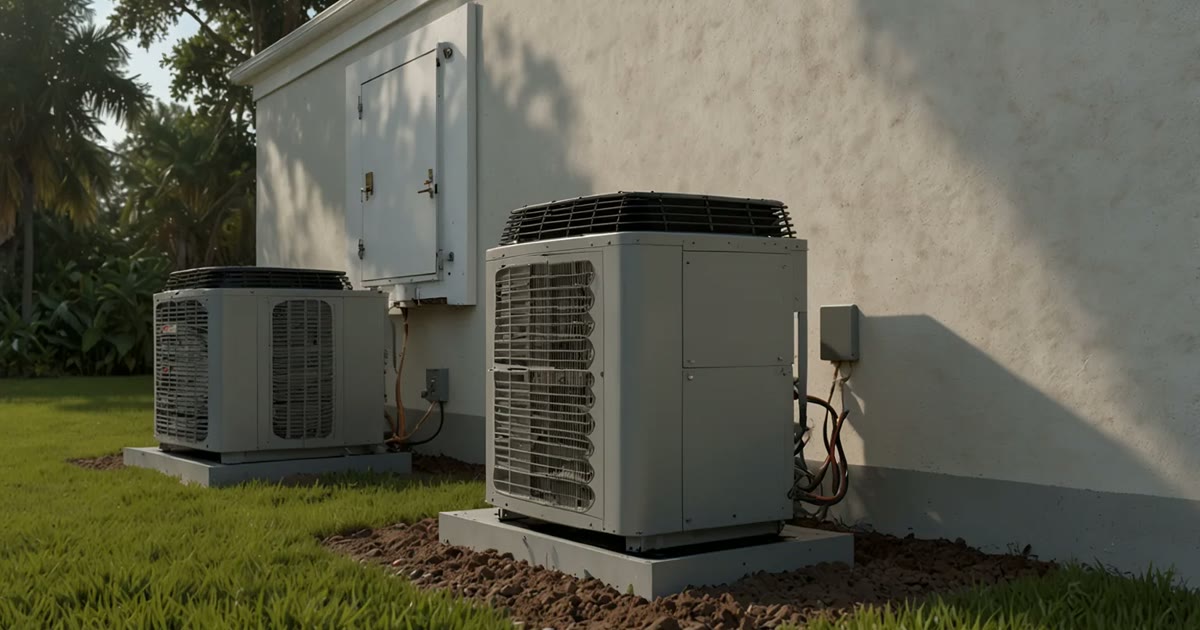
In practice, the equipment is the same. What changes is the environment it works in and how quickly you need help when it fails. In dense Fort Myers neighborhoods and Cape Coral canal subdivisions, homes sit close together, condensers sit on slabs inches from walls, and airflow around the outdoor unit is often restricted. Restricted airflow raises head pressure, and raised head pressure kills compressors.
City lots also mean the outdoor unit often lives in a fenced side yard where grass clippings, hedge trimmings, and storm debris accumulate. We pull more clogged condenser coils out of tight side yards than out of open lots. A coil packed with clippings can look fine from three feet away and still be starving for air.
Then there is the response-time question. A household with kids, elderly residents, or someone working nights from home feels a cooling failure immediately. In a dense service area like ours, a contractor can usually reach you faster than in a rural county, which matters when an afternoon in a shut-up Florida house is not just uncomfortable but genuinely unsafe for some people.
How often does an AC system need service in Southwest Florida?
Twice a year is the honest answer for most homes here, though many homeowners get by with one thorough maintenance visit annually. A system in Punta Gorda or Estero that cools a single-family home runs more cumulative hours than a comparable system in Ohio runs in two or three years. Runtime is what wears parts.
A proper maintenance visit covers more than a rinse. It includes checking refrigerant charge against the manufacturer's specs, measuring temperature split, inspecting the capacitor and contactor, clearing the condensate drain line, and checking amp draw on the compressor and fan motors. Skipping the drain line is the mistake we see most often. A clogged condensate drain in a Florida attic shuts down the system or, worse, stains a ceiling.
For a walkthrough of what a visit should include, see our guide to AC maintenance in Southwest Florida.
Why do emergency repair calls spike in June through September?
Because that is when a marginal part finally gives out under maximum load. Our own service records tell a clear story: during summer months, emergency repair calls make up the largest share of our dispatches, while scheduled maintenance holds steady year round. Homeowners who scheduled tune-ups in March and April mostly avoid the August phone call.
The pattern is simple. April through May, maintenance visits lead our schedule. June through September, emergency repairs take over, driven by failed capacitors, worn contactors, low refrigerant from slow leaks, and coils that could not keep up once afternoon temps held in the mid-90s. October brings a second small bump as systems that limped through summer finally get attention.
September in Lee County is the hardest month on equipment. The system has run flat out since May, the coils are dirtiest by then, and afternoon thunderstorms knock out power in ways that stress boards and capacitors on restart.
How do you know whether to repair or replace your AC?
Start with three questions: how old is the system, what refrigerant does it use, and what is the history of failures. A ten-year-old R-410A system with its first failed capacitor is a repair, almost every time. A fifteen-year-old R-22 system with a failed compressor is usually a replacement, because R-22 is phased out and scarce, and a new compressor into an aging coil set is money into a system with a short remaining life.
Age alone does not decide it. We service well-maintained systems in Bonita Springs and Lehigh Acres running strong past fifteen years, and we see eight-year-old systems that were neglected and are done. Maintenance history moves the math more than the birthday does.
Frequency is the second signal. One repair in five years is normal. Three repairs in eighteen months is a pattern, and patterns usually end with a compressor or evaporator coil failure, which are the two most expensive components in the box.
What size AC does your home actually need?
Sizing comes from a load calculation, not from the size of the old unit and not from a rule of thumb per square foot. The calculation accounts for square footage, insulation, window orientation, ceiling height, and occupancy. ENERGY STAR's sizing guidance gives a sense of the variables: each additional occupant adds roughly 600 BTU to the cooling load, and heavy shade on a home reduces the needed capacity by about 10% compared with a heavily sun-exposed same model.
Oversizing is the more common mistake in our area, and it is worse than it sounds. An oversized system cools the air fast, shuts off, and never runs long enough to pull humidity out. The result is a cold-clammy house, a damp-smelling home, and short cycling that wears the compressor. In Cape Coral, where many homes are block construction with tile floors and modest window area, we routinely right-size downward from what the original builder installed.
For more on how we approach equipment selection, read our page on AC installation for Fort Myers homes.
Which cooling option makes sense for your Florida home?
Most Lee and Collier County homes choose among three paths. Here is how they compare at a practical level.
| Option | Best for | Strengths | Watch-outs |
|---|---|---|---|
| Central split system (existing ductwork) | Single-family homes with intact ducts | Whole-home comfort, familiar parts, straightforward service | Duct condition matters; leaky ducts waste cooled air into the attic |
| Ductless mini-split | Additions, garage conversions, homes without ducts | Zone control, no duct losses, good for rooms that run hot | Multiple indoor units raise installed complexity on whole-home jobs |
| Heat pump system | Homeowners replacing both heat and cool in one unit | One system handles both seasons, efficient in mild-winter climates like SWFL | Auxiliary heat strips run during rare cold snaps, which is when bills jump |
Takeaway: if your ductwork is sound, a central split system remains the workhorse choice for most Fort Myers area homes; ductless earns its keep on additions and problem rooms.
How much does humidity matter compared with temperature?
More than most homeowners expect. Two houses at 76 degrees feel completely different depending on relative humidity. Dry 76 is comfortable. Damp 76 feels like the system is barely working, because in a real sense it is not removing moisture fast enough.
A properly sized system pulls humidity during its long, slow cycles. That is another reason we push back against oversizing and against setting the thermostat way down in the evening. Deep thermostat setbacks force the system into recovery mode, where it cools hard but dehumidifies poorly. Setting 76 or 77 and leaving it there usually beats bouncing between 72 and 80.
If humidity is your persistent complaint even when temperature seems fine, that is a diagnostic clue. It can point to an oversized unit, short cycling, duct leakage, or a thermostat with poor dehumidification control. Our article on humidity control in Southwest Florida homes covers the fixes in detail.
What should you check before calling for AC repair?
Five things, and they take under ten minutes. First, the thermostat: batteries, mode set to cool, temperature set below room temperature. Second, the air filter. A filter loaded with dust restricts airflow and can freeze the evaporator coil, and a frozen coil produces exactly the warm-air symptom that convinces people the compressor died. Third, the outdoor unit: is it running, and is anything visibly blocking it? Fourth, the breaker panel: a tripped breaker for the air handler or condenser is a common and cheap fix. Fifth, the condensate drain overflow switch, if your air handler sits in the attic; a full drain pan shuts the system down on purpose.
If the breaker trips again immediately after you reset it, stop and call. A breaker that keeps tripping is doing its job, and forcing it back on risks damage. That is the moment to call (239) 810-9080 and let a technician find the reason.
From Fort Myers, Cape Coral, Naples, Bonita Springs, Estero, and Lehigh Acres, we run trucks across Lee and Collier Counties daily, and a mid-June call from Estero usually gets a faster window than you would expect from a Florida summer schedule. If you want a professional set of eyes on a system that is acting up, scheduling an AC diagnostic visit takes a couple of minutes online or one phone call.
How do you pick an AC contractor in your city?
Check the license first. Florida licenses HVAC contractors under the state Department of Business and Professional Regulation, and a legitimate contractor will give you a license number without hesitation. Ours is FL License #CAC1824318, and you can verify it on the DBPR site. Unlicensed work on refrigerant systems is not a paperwork technicality; it puts your equipment, your warranty, and your safety at risk.
Second, ask what the quote includes. A flat repair quote should name the parts, the labor, and whether the refrigerant, if any is needed, is priced per pound. Third, ask about warranties on both parts and labor and get the terms in writing. Fourth, be wary of anyone who quotes a replacement over the phone without seeing the home. Load calculations require a visit. Full stop.
Trust row: City to City HVAC, licensed Florida HVAC contractor #CAC1824318, serving Lee and Collier Counties from Fort Myers, Cape Coral, Naples, Bonita Springs, Estero, and Lehigh Acres.
Why does local knowledge matter for city air conditioning?
Because the failure patterns here are local. Salt air near the coast corrodes condenser coils and outdoor cabinet hardware faster than inland. Afternoon lightning and summer power flickers kill control boards. Storm season brings debris, surge damage, and the annual scramble when an outage leaves a system that will not restart on its own. A contractor who has worked this market for years recognizes these patterns in the first ten minutes on site.
Local knowledge also means knowing the housing stock. The difference between a 1970s Fort Myers ranch with original duct runs and a 2010s Cape Coral build with a modern air handler in the garage changes both diagnosis and repair options. Homes here often have the air handler in the garage rather than the attic, which makes some repairs simpler and faster than the same job in northern climates.
Frequently Asked Questions
How long do AC systems last in Southwest Florida?
Twelve to fifteen years is a realistic range for a well-maintained system here, shorter than the national average because our cooling season is so long. Coastal homes with salt exposure often run toward the lower end. Consistent maintenance, clean coils, and correct refrigerant charge are the three factors that most extend equipment life in this climate.
How often should I replace my AC filter in Florida?
Check it monthly during cooling season and expect to replace it every one to three months depending on filter type, pets, and household dust. Our long runtime means filters load up faster here than the packaging suggests. A one-inch filter in a busy household during August can need replacement in under a month, while a media filter may last six months or more.
Why is my AC running but not cooling the house?
The most common causes are a dirty filter freezing the evaporator coil, low refrigerant from a leak, a failed capacitor in the outdoor unit, or a clogged condensate drain tripping the safety switch. Check the filter and breaker first. If those are fine and the outdoor fan is not spinning, schedule service rather than continuing to run the system.
What temperature should I set my thermostat in a Florida summer?
Most SWFL homeowners land between 76 and 78 degrees for a balance of comfort and runtime, and holding a steady setting beats large day-night swings in this humidity. Constant setbacks force the system into short, hard recovery cycles that cool the air but leave moisture behind, which is why a steady 77 often feels better than a bouncing 72.
Do I need a permit for AC replacement in Lee or Collier County?
Yes, both counties require permits for system replacement, and a licensed contractor pulls them as part of the job. The permit protects you: it means the installation gets inspected, which matters for code compliance, insurance, and eventual resale. If a contractor offers to replace your system without a permit, that is a reason to keep looking.
City to City HVAC is a Florida-licensed HVAC contractor, license #CAC1824318, based in Fort Myers and serving homeowners across Lee and Collier Counties. Every technician we send works on residential air conditioning in this market, in this climate, every day.
Ready to get your system looked at? Call City to City HVAC at (239) 810-9080 or use the quote form above, and we will get a licensed technician scheduled.