
Frequently Asked Questions Cape Coral Homeowners Ask About AC
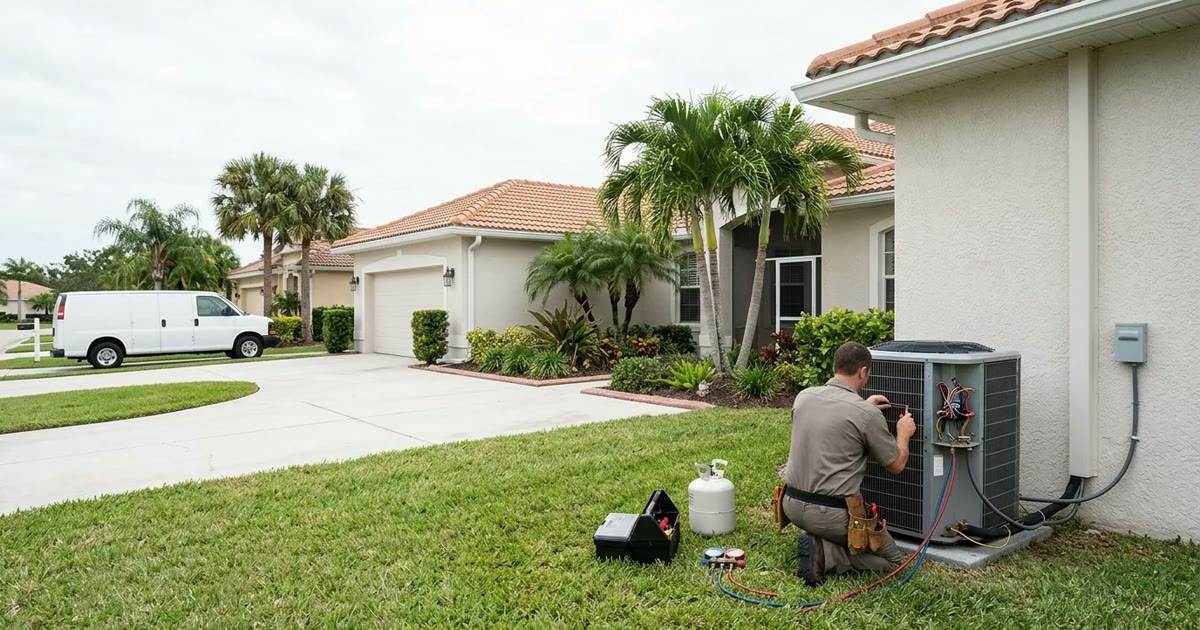
An AC FAQ page is a plain-language list of the questions Cape Coral homeowners most often ask a licensed air conditioning contractor, answered directly so you can act without digging through sales pages.
Short answer: Cape Coral homes run air conditioning most of the year, so the questions we hear daily come down to a handful of topics: how often to service a system, when repair stops making sense, why salt air and humidity wear equipment faster here than up north, what sizing actually means, and what to do first when a unit quits on a July afternoon. Below, we answer those questions the way we'd answer them standing in your driveway, with real numbers where we have real numbers. If your system is down right now and you'd rather talk to a person, call us at (239) 810-9080 and we'll walk you through it.
How often should I service my AC in Cape Coral?
Twice a year is the honest answer here, not the once-a-year answer you'll read in most national articles. A system in Southwest Florida runs nearly year-round, and our coastal air loads up evaporator and condenser coils with salt and pollen that a single spring tune-up won't stay ahead of.
What a service visit actually covers matters more than the frequency. A real maintenance visit includes checking refrigerant pressures, cleaning the condenser coil, clearing the condensate drain line, testing capacitors and contactors, and measuring airflow. A visit that only sprays the outdoor unit with a hose and hands you an invoice isn't maintenance, and we'll say that plainly.
Between visits, change your filter. It's the single highest-value thing a homeowner does. In heavy cooling season here, a one-inch filter can load up in a month. A restricted filter starves the blower, drops airflow, and eventually ices the coil, which is one of the most common calls we run in Fort Myers and Cape Coral neighborhoods every August.
Why does my AC break down more in Florida than it did up north?
Three reasons, and they stack. First, runtime: a system that ran 600 hours a year in Ohio runs closer to 2,000 here. Wear tracks hours, not calendar years. Second, corrosion: Cape Coral sits at sea level, and salt-laden air eats condenser coils, cabinet screws, and electrical connections faster than inland climates do. Third, load: our humidity makes the system work longer per degree of cooling because it's wringing water out of the air, not just dropping the temperature.
None of this means Florida equipment dies young by design. It means the maintenance interval and the quality of the install matter more here. A system installed level, with a correct charge and a clean drain path, on a raised pad away from standing water, outlasts a rushed install by years. We've pulled 15-year-old units off roofs in good shape and 7-year-old units that were neglected from day one.
When is repair no longer worth it, and replacement makes sense?
The rule of thumb most contractors use weighs age against cost: if the repair approaches half the price of a new system and the unit is past the middle of its expected life, replacement usually wins. Around here, expected life for a well-maintained system runs roughly 10 to 15 years, shorter for coastal installs with heavy corrosion exposure.
But age alone shouldn't decide it. Ask three questions. Is the repair a single failed part (a capacitor, a contactor, a blower motor) or a compressor or coil leak? Has the system kept its efficiency, or has your FPL bill crept up year over year? Does it hold temperature on the hottest afternoons, or does it fall behind? A 9-year-old system with one dead capacitor is an easy repair call. A 13-year-old system with a leaking evaporator coil and rising bills is a different conversation.
Refrigerant matters too. R-22 systems are phased out, and recharging one is expensive when the refrigerant can even be sourced. If your system predates 2010 and needs a major refrigerant-side repair, ask the technician to price both paths before committing.
What size AC does my Cape Coral home really need?
Size is calculated, not guessed. A proper load calculation counts square footage, insulation, window area and orientation, ceiling height, and how much sun and shade the house gets. Any contractor who sizes a system by the old unit's tonnage without running a load calc is guessing, and guessing shows up on your electric bill for the next 15 years.
Two adjustments surprise homeowners. Extra occupants add load: ENERGY STAR's guidance for room air conditioners adds about 600 BTU for each additional person regularly in the space, and the same logic applies to how hard a central system works in a full house versus an empty one. Shade works the other way: a heavily shaded room needs roughly 10% less capacity than a sunny one, per the same ENERGY STAR sizing guidance. Underestimating occupancy or overestimating shade both produce systems that short-cycle, leave humidity hanging in the air, and wear out faster.
Florida's building stock makes this worse. Older Cape Coral homes with original insulation and single-pane sliders have very different loads from a 2018 build with modern windows, even at identical square footage. The calculation is the only way to know.
What should I check before calling for AC repair?
Five things, in order, and they resolve a surprising share of no-cool calls.
Check the thermostat: batteries die, modes get bumped to heat or off, and schedules override what you set. Check the filter: a clogged filter can shut cooling down entirely. Check the breaker and the disconnect switch at the outdoor unit; both get tripped more often than you'd think. Look at the outdoor unit, and if it's iced over, shut the system off at the thermostat and let it thaw, because running a frozen coil damages the compressor. Check for standing water at the air handler, which usually means a clogged condensate drain and an overflow switch doing its job.
If all five check out and the system still isn't cooling, that's our call to make. Beyond that point you're dealing with refrigerant, capacitors, or control boards, and those jobs need a licensed technician with gauges and meters. If you're at that point, call (239) 810-9080; describing what you've already checked gets our techs to the answer faster.
Repair, replace, or maintenance plan: which option fits my situation?
Most homeowners land on one of three paths, and the right one depends on system age, the nature of the problem, and how the equipment has been treated. The comparison below lays out the tradeoffs at a glance.
| Option | Best fit | Typical timing | Main tradeoff |
|---|---|---|---|
| Repair | Younger system, single failed part, first breakdown | Same-day to next-day for common parts | Repeated repairs on an aging system add up |
| Replacement | System past mid-life needing compressor or coil work | Scheduled install, usually within days | Higher upfront commitment |
| Maintenance plan | Any working system, especially coastal installs | Two visits per year | Requires consistency to pay off |
The takeaway: repair what's young and simply broken, replace what's old and failing at its core, and put a maintenance plan under whichever system you keep, because salt air doesn't take years off.
What do Cape Coral AC service calls actually look like?
People assume every call is an emergency. Our dispatch mix tells a different story. The bulk of what we send trucks out for is scheduled repair work, followed by emergency and after-hours calls, routine maintenance visits, and full system installations. The chart below shows that mix across our SWFL fleet.
Read that way, the picture is encouraging: the biggest slice of our work is fixable, scheduled, ordinary repair, and the true middle-of-the-night emergencies are the smallest. The mix also says something about prevention, since a large share of emergency calls start as small problems a maintenance visit would have caught.
How does Southwest Florida's climate change basic AC advice?
Nearly every national guideline assumes a shorter cooling season and drier air. The EIA's residential energy survey found 88% of US households use air conditioning, with the South leading at 93% and single-family homes at 90%, and that concentration shows in how equipment ages here versus elsewhere.
Practically, that means three adjustments to standard advice. Treat the manufacturer's minimum service interval as a floor, not a target. Watch your condensate drain, because our humidity produces far more water per day than a dry-climate system ever sees, and a clogged drain in a Florida August becomes an indoor water problem within hours. And rinse the condenser coil gently a couple of times a year between professional cleanings; coastal salt film is the quiet killer of outdoor units from Punta Rassa to Pine Island.
Humidity is also why short-cycling matters more here. A system that runs in short bursts cools the air but never pulls enough moisture out of it, so the house feels clammy at 74 degrees. Longer, steady cycles are what wring the water out, which is one more reason correct sizing beats oversized equipment.
Where we work
We're a licensed Florida contractor serving Lee and Collier counties, with daily routes through Fort Myers, Cape Coral, Naples, Bonita Springs, Estero, Fort Myers Beach, Lehigh Acres, Sanibel, and Marco Island. Being local matters for AC work: we know which Cape Coral neighborhoods sit on wells with hard water feeding the condensate lines, where coastal corrosion hits hardest, and what our suppliers stock when a capacitor fails on a Sunday.
If you're comparing contractors, our full service list covers what we handle, and our Cape Coral AC repair page goes deeper on response times and common fixes in your area. For the broader picture of keeping a system alive in this climate, see our guide to AC maintenance in Florida's climate, and our replacement planning guide walks through the decision points before you commit to new equipment.
Every one of our techs works under our Florida license, #CAC1824318, and we've been doing this work across Lee and Collier counties long enough to know what these systems do here, not just what the manual says they should do.
When a repair estimate surprises you, a second opinion from a licensed local tech is usually worth the hour it takes, and scheduling one is as simple as a call or the quote form below.
Frequently asked questions about AC service in Cape Coral
How fast can a tech get to my house in Cape Coral?
For standard repair calls, we schedule same-day or next-day depending on when you call and where you are in our route coverage. True emergencies, like a total failure during peak season, get prioritized ahead of routine work. Calling early in the day gives you the widest choice of windows, and telling the dispatcher exactly what you've already checked shortens the visit itself.
Do I really need twice-a-year maintenance in Florida?
For most systems here, yes. A system that runs most of the year in coastal air collects coil corrosion and drain-line buildup faster than the once-a-year national baseline assumes. Spring and fall visits catch refrigerant drift, failing capacitors, and clogged drains before they become breakdowns. At minimum, never skip the annual visit, and change filters yourself between visits.
Can I do any AC work myself?
Filters, thermostats, breakers, and keeping the outdoor unit clear of vegetation are homeowner territory. Anything involving refrigerant, the electrical panel, or opening the air handler belongs with a licensed technician, both for your safety and because Florida requires HVAC work to be done under a contractor's license.DIY refrigerant work also risks damage that voids equipment warranties.
Why is my electric bill so high in summer even with AC running?
The usual suspects are a dirty filter restricting airflow, a condenser coil caked with salt and dirt, low refrigerant from a slow leak, or duct leakage into a hot attic. Each forces longer run times. An honest technician measures rather than guesses: airflow, temperatures, and pressures tell the story quickly, and the fix is often inexpensive relative to the monthly waste.
What brand of AC equipment should I buy?
Installation quality matters more than the badge on the cabinet. A correctly sized, carefully installed mid-tier system from a major manufacturer will outperform a premium unit slapped in with a rough install. Ask any bidder about load calculations, coil corrosion protection for coastal homes, and warranty registration. Compare bids on the details, not just the brand name.