Emergency AC Repair in Fort Myers & Southwest Florida: What to Do When Your AC Dies
When your air conditioner quits in a Florida summer, you need a decision, not a research project. First, check the thermostat batteries, the breaker panel, and the air filter — those three things cause a large share of no-cool calls. If the system still won't run, turn it off at the thermostat so a failed component doesn't cause more damage, and call a licensed contractor. City to City HVAC answers emergency calls across Lee and Collier Counties at (239) 810-9080. A licensed technician can diagnose whether you're looking at a capacitor, a contactor, a frozen coil, or a compressor, and give you the real options before any work starts.
Emergency AC repair is the urgent diagnosis and fix of an air conditioning system that has stopped cooling, stopped running, or is unsafe to operate — usually called in when a home can't be kept livable without it.
Key Takeaways
- Check the thermostat, breaker, and filter before you call — it saves a trip charge if one of those is the whole problem.
- Turn the system off if it's short-cycling, humming without cooling, or blowing warm air; running a failing compressor makes the repair bigger.
- In Southwest Florida, a dead AC is a same-day problem, not a next-week problem — heat and humidity make an uncooled house uncomfortable fast.
- Emergency repair calls spike through the summer months; scheduling maintenance in spring is the practical way to avoid the wait.
- City to City HVAC is licensed in Florida (#CAC1824318) and serves Fort Myers, Cape Coral, Naples, Bonita Springs, Estero, and Lehigh Acres.
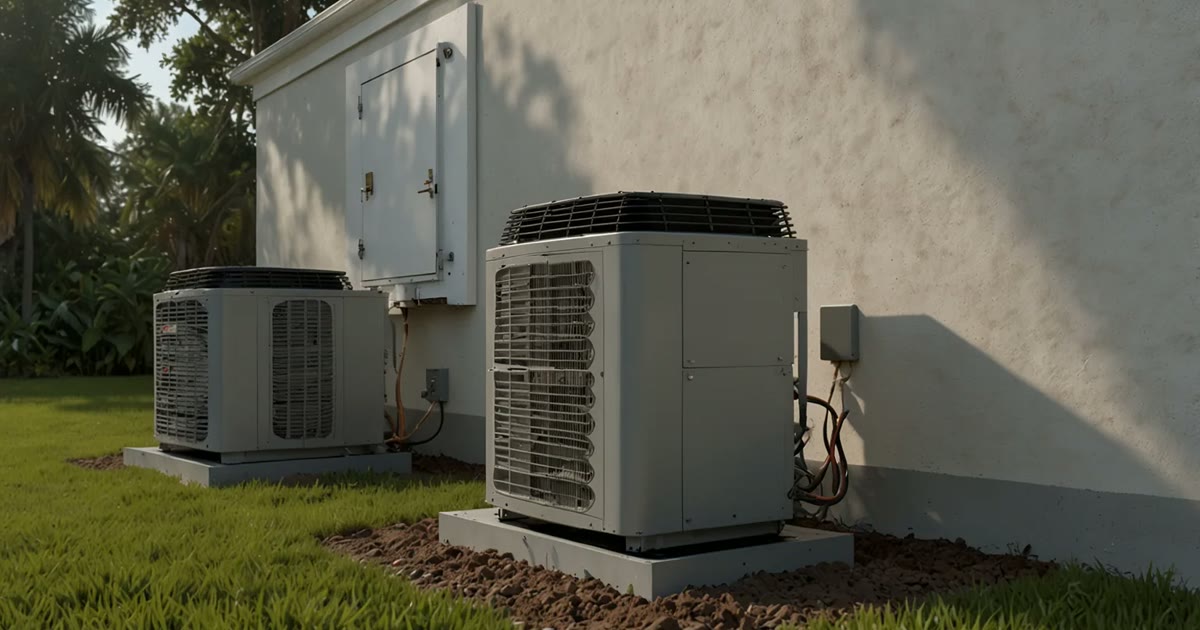
Is a broken AC actually an emergency in Florida?
Yes — and not because a salesperson says so. Nearly every Florida home depends on air conditioning: the EIA's 2020 Residential Energy Consumption Survey found 88% of U.S. households use AC, rising to 93% in the South region, and 90% of single-family homes nationwide (EIA). Here, the AC isn't a comfort upgrade. It's what keeps indoor humidity down and the house livable through a nine-month warm season.
When the system dies in July, indoor temperatures climb into the high 80s within hours, and moisture starts settling on everything — mattresses, drywall, electronics. That's why we treat no-cool calls in occupied homes as urgent, and why most of our emergency calls come in during the afternoon, when a struggling system finally gives up on the hottest day of the week.
What should I check before calling for emergency AC repair?
Three things, in this order. First, the thermostat: dead batteries or a switch flipped from COOL to HEAT or OFF account for more no-cool calls than most people would guess. Second, the breaker: find the HVAC breaker in your panel and check whether it's tripped. If it tripped once, reset it once. If it trips again, stop — repeated tripping means a real electrical fault, and resetting it over and over can damage the compressor.
Third, the filter. A filter clogged with pet hair and dust chokes airflow, the evaporator coil gets too cold, and the coil ices over. A frozen coil looks like a broken AC but it's often a five-dollar filter and a few hours of thawing. If the filter is gray and matted, shut the system off, let it thaw, swap the filter, and see if cooling returns.
If all three check out and the house is still warming up, that's the point to call. Have this ready: the system's age if you know it, whether it's blowing warm air or nothing at all, and any sounds it made before it quit. A grinding or squealing noise before failure points to a motor or bearing. Silence points to electrical. That detail shortens the diagnostic.
What causes most emergency AC breakdowns in Southwest Florida?
Capacitors, contactors, and dirty condenser coils top the list. A capacitor is a small part that gives the compressor and fan motors their starting jolt, and Florida's heat and voltage swings kill them regularly. It's a common, same-visit repair — the failure is dramatic (system hums or clicks but won't start) but the fix is quick.
Corrosion from salt air is the local wildcard. Homes in Cape Coral, Fort Myers Beach, and Naples put condensers through salt-laden air that eats coils and electrical connections faster than inland systems in Lehigh Acres or Estero. Add summer thunderstorms and the power flickers that come with them, and you get the surge-related failures that follow every big storm cell.
Refrigerant leaks are the slower category. A system that cools weakly for weeks before dying usually has a leak, and the repair conversation is different: depending on the system's age and the leak's location, a repair-versus-replace decision comes into play. We lay out both paths with real numbers before anyone commits to anything.
How fast can an emergency AC repair get done here?
Same-day response is the norm for true no-cool calls in our service area, because everything is close — Fort Myers to Cape Coral is twenty minutes, Bonita Springs to Estero less. What actually determines the timeline is call volume, and call volume follows the weather. The chart below reflects our own service records across the year.
Read it this way: through the mild months, scheduled repairs and maintenance visits make up most of the day. Once the summer heat settles in, emergency repair calls take over the schedule. That pattern is the honest reason to plan ahead — a system tuned up in March or April is far less likely to join the summer pileup, and if it does need help anyway, you're calling from a shorter line.
Should I repair or replace a dead AC?
It depends on three numbers: the system's age, the repair cost relative to replacement, and how often it's been breaking down. A ten-year-old system with a failed capacitor is an easy repair call. A fifteen-year-old system with a failed compressor is usually a replacement conversation, because a compressor is the most expensive single part in the unit and the rest of the system isn't far behind it.
There's a middle zone, and that's where a straight answer matters most. We give you the repair price and the replacement price side by side, plus what each path looks like over the next few years. No pressure toward either one — a repair that buys you three more good years is often the right call, and we'll say so when it is.
| What you're seeing | Likely cause | Typical response | Urgency |
|---|---|---|---|
| Unit hums or clicks but won't start | Failed capacitor or contactor | Same-day part replacement | High — call same day |
| Blowing warm air, coil has ice | Clogged filter or low refrigerant | Thaw, replace filter, then diagnose | Moderate — shut system off first |
| Breaker trips repeatedly | Electrical fault or failing compressor | Technician diagnosis required | High — stop resetting the breaker |
| Weak airflow, runs constantly | Dirty coil, duct issue, or aging system | Cleaning and evaluation, repair-vs-replace talk | Schedule within days |
The takeaway: ice on the lines or a tripping breaker means shut the system off and call — running it makes both worse.
What does emergency AC repair cost?
We don't publish flat prices online because the honest answer depends on the part, the system, and what the diagnostic finds — a capacitor and a compressor are different conversations entirely. What we do promise is the process: a licensed technician diagnoses the system, tells you what's wrong in plain language, and gives you the price in writing before any work begins. You approve the number or you don't; nothing starts without your say-so.
If you're comparing contractors, ask each one the same question: is the diagnostic fee applied toward the repair? That single question tells you how a company structures its visits, and it's a fair one to ask us too.
Serving Fort Myers, Cape Coral, Naples, Bonita Springs, Estero, and Lehigh Acres, City to City HVAC handles emergency calls across Lee and Collier Counties — and if your situation turns out to be a replacement rather than a repair, our AC replacement guide walks through what that decision involves.
How do I keep an emergency from happening next summer?
Two habits prevent most of the calls we run. Change the filter on schedule — every one to three months depending on the filter and the household — because a starved coil is the most common self-inflicted failure we see. And get a maintenance visit once a year, ideally in spring before the heat arrives. A tech cleaning the condenser coil, checking capacitors under load, and verifying refrigerant charge catches the slow failures before they become Saturday-night emergencies.
Sizing matters too, and it's worth knowing if your system was ever replaced by a previous owner. An oversized unit cools the air fast but leaves humidity behind, which makes the house feel clammy and keeps the system short-cycling. If your AC has always seemed to run in short bursts and never quite dry the air, mention it at your next visit — it changes the replacement conversation later.
One more homeowner note from ENERGY STAR's guidance: shading matters. A unit in heavy shade gains roughly 10% in effective capacity compared with one in full sun, and room-by-room, each extra regular occupant adds about 600 BTU of cooling load (ENERGY STAR). Landscaping that shades the condenser — without blocking its airflow — is a small thing that pays back every summer.
Why does the same AC keep breaking down?
Repeat failures usually trace back to one of three roots. A system that was mischarged with refrigerant — overcharged or undercharged at a past repair — runs stressed and kills components early. A system with an underlying electrical problem, like a weak contactor arcing every cycle, takes out the parts downstream of it. And a system that's simply at end of life starts failing parts in sequence; fixing each one as it goes is a legitimate strategy for a while, but the pattern itself is information.
If you've had two or more significant repairs in two years, ask for a whole-system evaluation rather than another single-part fix. Sometimes the honest answer is that the repair treadmill has started, and putting that year's repair budget toward replacement instead is the better spend. We'd rather tell you that than sell you a third capacitor.
Between visits, our AC maintenance checklist covers the homeowner-side checks that keep small problems small, and our AC not cooling troubleshooting guide walks through the diagnostic steps in more detail if you want to understand what your technician is checking.
What to do right now while you wait for the technician
Close blinds and curtains on the sun-facing side of the house. Run ceiling fans — they don't lower the temperature, but they make the air feel several degrees cooler on skin. Keep the fridge and freezer closed. If anyone in the home is elderly, very young, or has a health condition affected by heat, and the indoor temperature keeps climbing past comfortable, plan a cool place for them to spend the hottest hours rather than riding it out.
And resist the urge to keep resetting a tripping breaker or chipping ice off the coil yourself. Both make the eventual repair more expensive, not less.
City to City HVAC — Florida License #CAC1824318 · Serving Lee & Collier Counties · Fort Myers, Cape Coral, Naples, Bonita Springs, Estero, Lehigh Acres
Frequently Asked Questions
How quickly can you get here for an emergency AC repair?
For a no-cool call in an occupied home, we prioritize same-day response across Fort Myers, Cape Coral, Naples, Bonita Springs, Estero, and Lehigh Acres. Exact timing depends on call volume, which peaks on the hottest afternoons of summer. When you call, tell us the situation honestly — a house with vulnerable occupants or a fully dead system gets prioritized over a partially cooling one.
Should I turn my AC off if it's not cooling?
Yes, in most failure modes. If it's blowing warm air, short-cycling, humming without starting, or has ice on the refrigerant lines, shut it off at the thermostat. Running a failing compressor or a frozen system turns a small repair into a large one. The exception is a system that's cooling weakly but still cooling — in that case, note the symptoms and call for a scheduled diagnosis.
Why is my AC running but the house isn't getting cooler?
The most common causes are a clogged air filter starving the coil, a refrigerant leak that has slowly depleted the charge, a dirty condenser coil dumping heat poorly, or a failing compressor that runs but no longer pumps effectively. Start with the filter since it's free to check. If the filter is clean and the outdoor unit's coil isn't clogged with grass or debris, it needs a technician's gauges to diagnose properly.
Is it worth repairing a 15-year-old AC unit?
Sometimes, depending on what failed. A capacitor or contactor on a 15-year-old system can be a reasonable repair that buys real time. A failed compressor or a leaking coil on that same system usually tips toward replacement, because those repairs consume a large share of a new system's cost on old equipment. Ask for both numbers in writing and compare them against the system's remaining expected life.
What can I do to prevent emergency AC breakdowns?
Change the filter every one to three months, keep grass clippings and landscaping debris away from the outdoor unit, and schedule a professional maintenance visit each spring. Maintenance catches weak capacitors, low refrigerant, and dirty coils before they fail on the hottest day of the year — which is exactly when our emergency call volume spikes and wait times are longest.
When the AC quits, you don't need a lecture — you need a licensed tech with a capacitor on the truck. Call City to City HVAC at (239) 810-9080 and we'll get a diagnosis moving today.